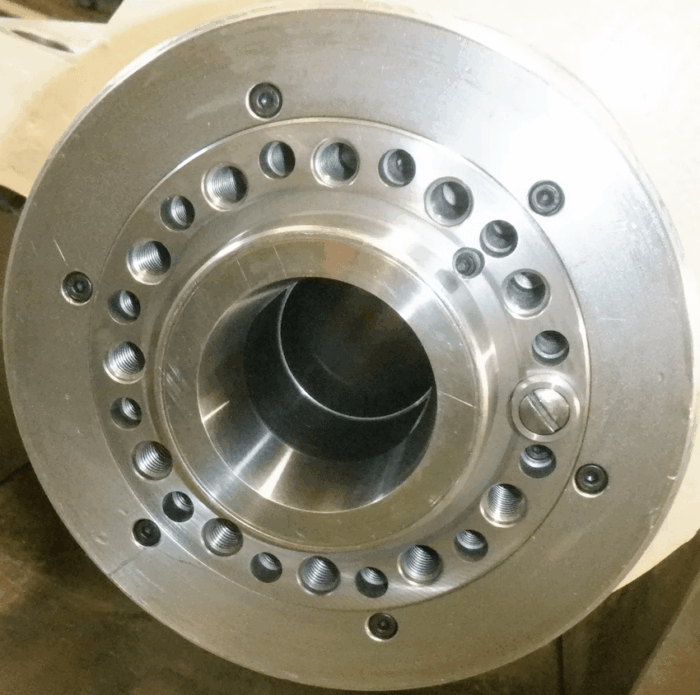
Get a full evaluation of your spindle.
Send us your spindle, we will diagnose your problem and provide you with an accurate price quote for repair.


One of the most valuable tools for identifying spindle issues is sound. Spindle assemblies vibrate naturally during operation, but excessive vibration that causes unusual noise is a sign that something could be wrong.
Read More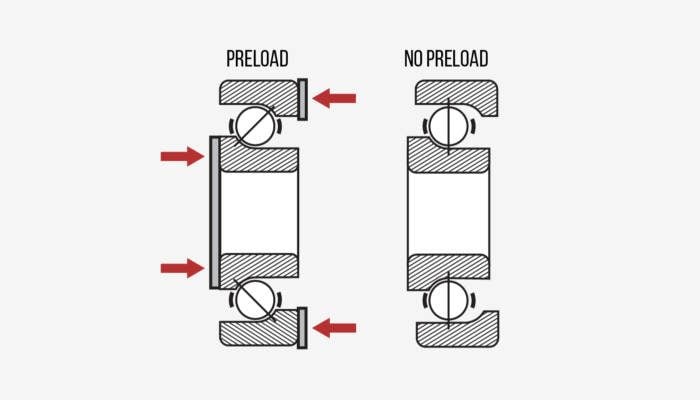
In this helpful guide to spindle bearing preload, Northland Tool & Electronics will answer all the basic questions about your spindle bearing preload calculations. More importantly, we’ll discuss exactly why this is so crucial to the performance and longevity of your spindle. What Is Spindle Bearing Preload? First, let’s define preload. Preload is a predetermined static load that applies to all rolling components evenly. Specifically, bearing preload keeps the rolling elements in constant contact with the races to ensure that the dynamic loads, while in use, are exactly where they need to be to maximize accuracy and spindle life span.
Read More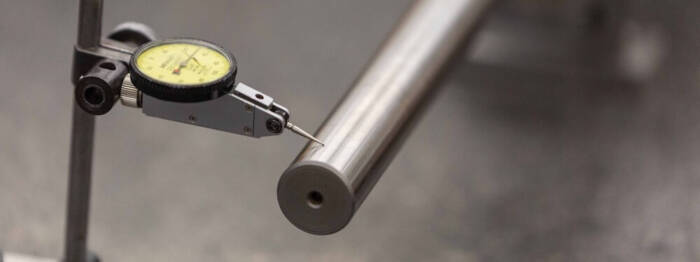
In machining, runout refers to inaccuracies in a tool or piece of equipment that cause it to spin off its ideal axis. Spindle runout occurs when a spindle no longer rotates on its intended axis, which can result in: Inaccurate machine registration Issues with tolerance control Excessive chip load Poor part finishes Insufficient tool life Because of these risks, it’s recommended that you test your spindles for runout regularly and obtain necessary repairs as soon as possible. There are two types of spindle runout: radial and axial. Both can lead to similar issues.
Read More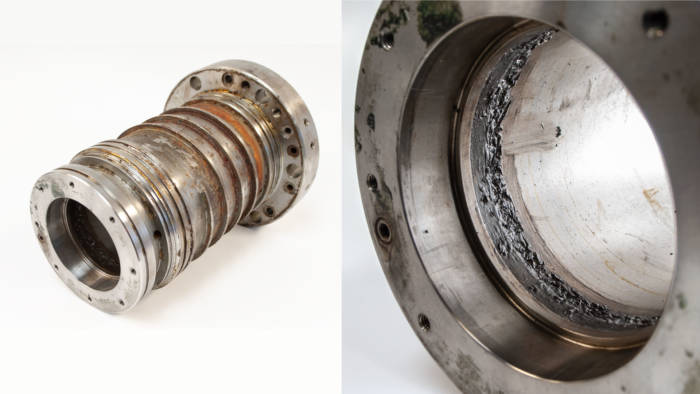
Running this spindle too long caused deformed ball bearings and damage to the outer race Damage to the outer race is consistent with prolonged operation after spindle exhibited initial signs of needing to be rebuilt Every spindle rebuilt by Northland Tool is backed by a 1-year warranty on parts and workmanship Over 2 years in the making A customer reached out to us over 2 years ago with a complaint that their spindle was starting to get noisy. We provided an estimated cost of $5,000 to rebuild.
Read More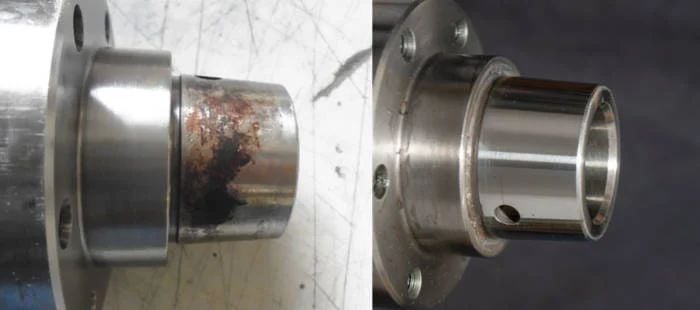
When a cylindrical surface, such as the OD of a shaft or the ID of a tooling taper, becomes worn or damaged, we use a process referred to as grind-plate-grind (GPG) to restore dimensions to original OEM specification. First, we pre-grind, also referred to as “green grind,” to remove a thin layer of material and smooth any damage. Next, the part undergoes an electroplating process to apply a layer of hard chrome to the desired area. This builds up a durable surface that is slightly oversized than the final desired dimension.
Read More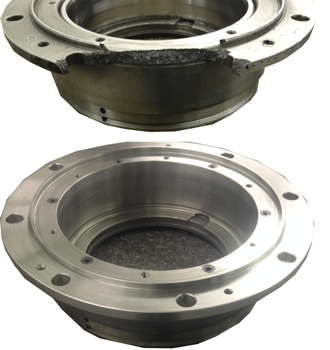
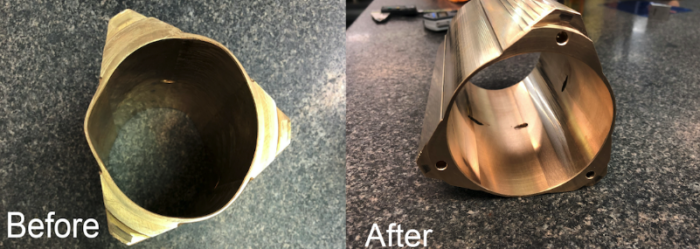
Since you can’t go to the local parts store and buy a front spindle housing and the lead times from the OEM can be measured in months not days, if they will even sell you the part. We manufacture replacement parts here to keep you up and running. Northland Tool manufactured this part, with micron tolerances, in 4 days and had our customer up and running in less than 7 days.
Read More
Spindle bearings must be properly lubricated to maintain a film of lubricant between the rolling elements and the bearing raceways. Without lubrication, the rolling elements will have direct contact with the raceways, and this will result in heat, race deterioration, rolling element deterioration, cage disintegration, and ultimately bearing/spindle failure. There are several methods of lubrication used for spindles.
Read More